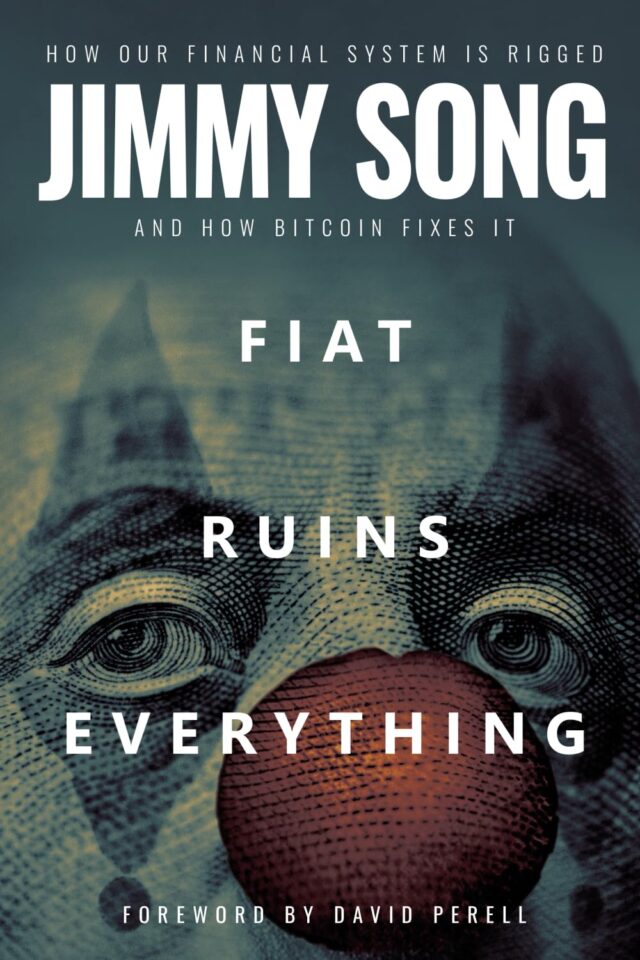
Fiat Ruins Everything: How Our Financial System Is Rigged and How Bitcoin Fixes It
To a nocoiner, saying that something is “reversing the decline of civilization” sounds ludicrous — especially if that something is some arcane technobabble on the internet. Even if they were to accept that (Western?) civilization and its ideals of liberty, prosperity, and individuality are on the road to ruin, that Bitcoin could fix that seems hyperbolic.
The further down the rabbit hole you’ve gone and the longer you’ve seen the transformative power of Bitcoin in your own life, the less insane becomes the proposition that Jimmy Song advances in Fiat Ruins Everything. For those whose lives Bitcoin has touched, it is obvious that “the transformative effects of a Bitcoin-driven future extend well beyond commerce and technology, reaching deep into the fabric of society” (page 292). The book attempts to investigate the “the sordid depths of [fiat’s] second and third-order effects” (page 2).
Fiat isn’t just a monetary system, but a mentality and a morality. It’s a belief that something can be had for nothing, that all that is needed is a loud enough voice: “The fiat mentality is the illusion that you can decree something into reality just by saying so” (page 259). Fiat morality involves silly virtue-signaling (“a misnomer because it is unconcerned with displaying traditional virtue”, page 31) — things like putting Ukrainian flags in one’s profile picture or preferred pronouns in emails. Grow up. Song correctly observes that the flip-flopping across the plethora of Latest Things™ is as ridiculous and impermanent as Ethereum’s monetary policy.
The faithful reader of the author’s Songsheet columns for Bitcoin Magazine will recognize the themes, but many of the chapters are new creations in different packaging. The absurd comparisons and ranty jokes that go so well in fast-paced articles online would have been tiresome in a book and are here kept at a minimum. Even though the chapters form a coherent whole, they can be read independently, a few short pages before bedtime (since only a fiat mind would use screens before sleep, right?).
Toxic maximalism is not just an immune system keeping the beliefs pure. It’s a rejection of the fiat model of sacrificing belief for money (page 42).
The topics covered range across absolutely everything, from the private and intimate to the global and universal. Song really shines when he takes apart the modern work environment, the bullshit jobs, and the proliferation of administrators. Real estate is a shitcoin scam, propped up by insiders just as much as the pre-mined altcoin founders he routinely rallies against. Wind and solar energy are the altcoins of energy — fake, unreliable, and operating only via propaganda and subsidies. College is a multi-level marketing scheme:
The best that non-upper-class people can hope for is to graduate into the rent-seeking class. They, too, can get an administrative position by scamming middle-class families out of hundreds of thousands of dollars and spreading the lie that college is the key to wealth (page 154).
Tech giants and the digital economy don’t escape the onslaught either:
“[W]hile companies present their services as free, [they] subtly monetize their users through advertisements. The entire scenario bears a striking resemblance to the principles of fiat money: everything appears free, but hidden costs subtly erode the value of the goods or services. Everyone is trying to scam everyone else” (page 133).
Where he misses his mark is in Part 4, where he echoes rallying cries that Bitcoiners often chant: that government is predominantly financed by money printing and that it prolongs wars. The directions are correct but the magnitudes are severely off.
Printing money does mischievously siphon economic value from money holders to the government issuer, which puts additional resources at a warring government’s command — though that falls somewhat short of “dedicating all available resources to the war effort and leading to widespread destruction and loss of life” (page 169).
The historical twist is that governments on sound money — in the nineteenth century and even during World War I — just abandoned the monetary fetters that ordinarily would “constrain” them. Practically speaking, sound money has never prevented warmongering state officials from waging the war they desired.
Even worse is chapter 20 (“Taxes Are Revenue Theatre”) where Song must have caught an infectious strain of modern monetary theory (MMT). “Taxes are theater, a magic show to distract us from the wizard behind the curtain” (page 187), he writes, turning into a less eloquent version of Stephanie Kelton. “We could eliminate all taxes, abolish the IRS and eliminate a ton of needless bureaucracy, but we don’t because it would destroy people’s illusions about the monetary system. Taxes are revenue theater, a show to deceive us about our monetary system”.
Deep breath. Fiat money holdings and the Fed propping up the Treasury market does make the government larger — and its debt financing cheaper — than it otherwise would have been. But by how much? One makes the public a disservice by telling them that taxes don’t matter. So far in Fiscal Year 2023 the federal government has spent 6,100 billion dollars, of which 4,400 billion (two-thirds) were raised in taxes. Yes, its ability to squeeze, regulate, and mandate is horrific and immoral — and having access to a money-printer helps support the debt markets that cover the rest — but taxes are far from “revenue theater”.
And as corrupting as politics is, it doesn’t really have control over money printing: We should consider ourselves lucky that the clown show that is politics only rarely extends to the Eccles building. For whatever inside-baseball and behind-the-scenes pressure that definitely goes on, politicians in direct control of the money printer would be a far worse monetary system than the already catastrophic one we have.
That aside, Song makes an excellent case that fiat money and fiat mentality are implicated in all that’s wrong with the world. Bitcoin might not, as the trope goes, truly fix everything — but ridding us of fiat, which had a role in ruining everything, must surely be a step in the right direction.
Select Quotes:
- “Many jobs in a fiat money society have a significant rent-seeking component. The degree of rent seeking in a job is often proportional to its involvement in politics. The more political the job, the more likely it is to engage in rent seeking” (page 12).
- “This game of posturing, perception, and propaganda kills, steals, and destroys. Politics is a zombie horde eating away at civilization and multiplying its destruction through the creation of even more zombies” (page 197).
- “Wind and solar are altcoins. They are unreliable, costly, and make as much sense as LUNA. ‘Green’ energy takes up too much real estate for the energy they provide, but they grow through propaganda and subsidization like preferred pronouns on LinkedIn” (page 233).
- “Investing and other societal components need to be anchored in reality. Fiat money is postmodern money. It’s nihilistic money. It’s a reality-ignoring money filled with theft, cronyism, and corruption” (page 96).
BM The Primary Issue (print) | Stacker News | Amazon (affiliate) | Konsensus (partner)