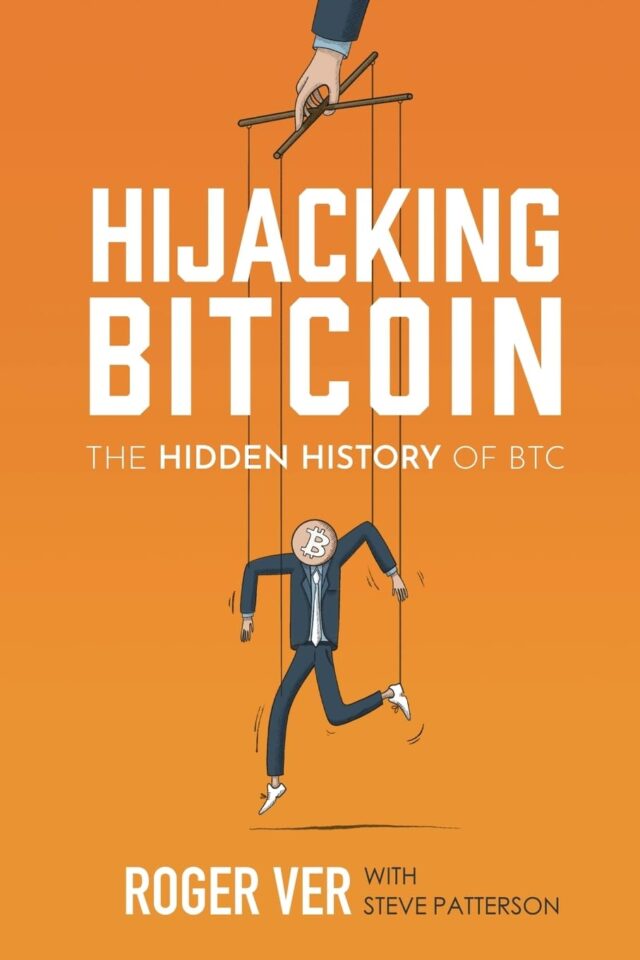
Hijacking Bitcoin: The Hidden History of BTC
Every few cycles Bitcoin is attacked by some megalomaniac character with a savior complex thinking they are uniquely situated to rescue Bitcoin from some existential threat. As we’re living through one of those attacks right now, looking back at the deranged ramblings of a loud loser from the previous fight is quite revealing.
In the eight years since the blocksize wars concluded, the debate over what happened has never been more relevant. In Hijacking Bitcoin, Roger Ver, the infamous character known as “Bitcoin Jesus” — cue savior complex — laid out his account for what happened.
The more I read Hijacking Bitcoin, the clearer it becomes that Luke Dashjr has turned into this cycle’s Roger Ver: a religious fervor against imagined threats, a twisted logic that includes words with nonstandard definitions, an obsession with a nefariously captured Bitcoin Core, and Peter Todd being the original villain (claims Ver) and a bad actor (says Dashjr).
Ranting over nefarious forces (the “spooks”) that have taken over Core reads like a well-articulated version of contemporary Twitter banter. Who the BTC maximalists with “narrative control” are remains unclear and ever-changing throughout the book — Bitcoin Core devs, the CIA, Adam Back, trolls on Twitter, exchanges, DDoS attackers, etc.
In both timelines, the urgency is the most ridiculous component: Dashjr thinks Bitcoin is under immediate legal threat — as if a nonpolitical, cypherpunky freedom tool ought to care much for laws — just as Ver thought Bitcoin was on the verge of dying in ~2015 because of full blocks and fee pressure.
The formula both gentlemen follow is roughly: Here is an imaginary problem I’m seeing, and if we don’t enact my extreme, disproportional fix, our beloved orange project is dead.
Hijacking Bitcoin is littered with warnings of on-chain Bitcoin payments costing hundreds or thousands of dollars — a cost theoretically possible with mass adoption, but which nobody has seen (outside, perhaps, a few weeks during the Ordinals craze in 2023 and a few months in 2017). It’s absurd to keep waving this flag of exorbitant fee harm in a mempool dominated by (sub-)1sats/vbyte transactions.
While their obsession with Core unites them, one way in which Ver and Dashjr differ is in directionality (Ver is quite happy for Bitcoin to store various nonmonetary data). Dashjr et al. are extremely upset with the OP_RETURN data limit increased in Core v30, thinking it an assault on “true”™ Bitcoin, whereas Ver & Co thought Core suddenly halving the OP_RETURN limit in 2015 was rugging developers building on Bitcoin. Ver approvingly quotes Vitalik in saying that the functionality Core rugged him of was “an act of war” (page 145).
The big-blockers, for whom Ver purports to speak, were obsessed with Bitcoin as intended or divining Satoshi’s original vision, and, like the devil citing Scripture, Ver recruits contrived Satoshi quotes to his cause.
What he says about Lightning is even more laughable. Ver quotes Saifedean Ammous and Tuur Demeester (from 2019), and uses the state of the Lightning Network back then to rebut their scaling-in-layers arguments. He misspells the name of a fringe Swedish politician, and quotes him saying (in 2018) that Lightning has failed. Lightning, Ver seems to believe, “results in frequent payment failures, especially for large-value transactions” (page 79), suggesting that the book, published in 2024, was written too many years ago.
His obsession with Mastercard (which he repeatedly mistypes as MasterCard, a convention the company changed in 2016, thus also dating the writing) is ironic on many levels: Ver traces some of the nefarious influence in Bitcoin, such as Blockstream and Adam Back, to the payment processor, which, in his mind, is “a direct competitor of Bitcoin” (page 136). Clarification: it’s a direct competitor to Ver’s view of bitcoin as an online (micro)payment system, a very narrow use case that fintech had largely fixed by the time Ver fought in the blocksize wars — and is entirely mistaken now that Bitcoin is entering its 18th year.
We don’t need faster payments; we need better money.
Still fighting the good fight til this day, Ver thinks BCH will overtake Bitcoin in due course: The decade-long market insanity that is BTC’s dominance over BCH will correct itself since users “are paying extremely high fees on BTC for no good reason, since the same product can be offered at a fraction of the cost” (page 30). It’s mistaken to think that “the price appreciation of BTC has vindicated the small block philosophy” (page 215), since bitcoin trades at its excessive ratio to BCH only because of widespread misinformation and censorship. My god.
The best steelman I can make of Ver’s lost bitcoin vision is that so much Lightning activity taking place via custodial wallets is a betrayal of censorship resistance and, in some part, a recreation of the permissioned money system we came from. That’s a reasonable argument, but also, like so much in the bcash worldview, not (yet?) a problem.
Ver’s service to the community is to highlight a history most newly arrived Bitcoiners won’t know: In the early days — when Venmo wasn’t there, fast online payments didn’t work, and convenient banking apps for payment and cross-border transfer weren’t commonplace — many Bitcoiners thought this clever blockchain idea could fill that void. Hence, the emphasis on micropayments and Mastercard. In the intervening decade, fintech caught up, and those payment-related use cases became redundant.
The conflict of vision between big-blockers (increasing blocksize, centralized nodes, cheap on-chain payments) and small-blockers (fee market, decentralized nodes/unforked network, layered scaling) is an eternally interesting question in blockchain economics.
The loser’s version of history is also worth looking at.
BM The Core Issue (print) | Stacker News | Amazon (affiliate)